Learn some particle accelerator basics from a Fermilab accelerator operator.
How do you keep a particle inside of an accelerator? Fermilab accelerator operator Cindy Joe explains.
Video URL
Have a burning question about particle physics? Let us know via email or Twitter (using the hashtag #asksymmetry). We might answer you in a future video!
The Fundamental Physics Prize Foundation will honor leaders at the Large Hadron Collider and its CMS and ATLAS experiments with a special $3 million prize.
When Sal Rappoccio, a postdoctoral researcher from Johns Hopkins University, joined the Compact Muon Solenoid experiment in mid-2007, he did what any newcomer would do. He tried to start his analysis. It did not go well.
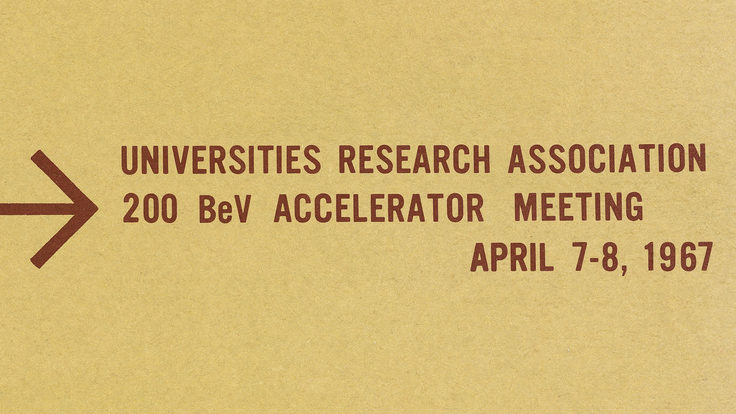
In 1967, 400 enthusiastic scientists met at Argonne National Laboratory to discuss plans to build a new 200 GeV accelerator and a national laboratory to house it.
The Gargamelle collaboration at the European laboratory CERN began operating its bubble chamber in the early 1970s, shooting neutrinos through 12,000 liters of Freon, a heavy liquid.
Symmetry often discusses the connections between particle physics and other parts of science, nature, and culture. This issue shows how broadly particle physics pervades other aspects of life.
When I was a kid, I used to watch animations on TV and read Manga magazines a lot. As you can imagine, my parents were not very enthusiastic about it at all.
For her latest work, choreographer Liz Lerman took members of her dance troupe to CERN, where they reveled in the fog, danced in the aisles and found inspiration in wide-ranging conversations with