Learn some particle accelerator basics from a Fermilab accelerator operator.
How do you keep a particle inside of an accelerator? Fermilab accelerator operator Cindy Joe explains.
Video URL
Have a burning question about particle physics? Let us know via email or Twitter (using the hashtag #asksymmetry). We might answer you in a future video!
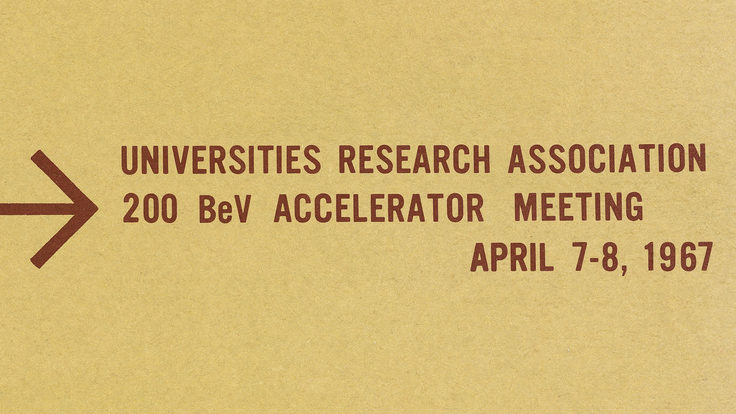
In 1967, 400 enthusiastic scientists met at Argonne National Laboratory to discuss plans to build a new 200 GeV accelerator and a national laboratory to house it.
The spotlight caught Todd Satogata. The camera zoomed in. “Did your particle beam shoot down a UFO?” the TV host asked. The accelerator physicist at RHIC, Brookhaven National Laboratory's Relativistic Heavy Ion Collider, smiled. Of course not.
If the proposed International Linear Collider (ILC) completes the evolution from physicists' dream to discovery machine, Jonathan Dorfan will know when and where the transforming moment occurred: August 20, 2004, in Beijing, China.
Physicist Les Cottrell is the meteorologist of Internet weather. His project tests the strength of Internet connections around the worldand finds Africa lagging farther and farther behind.
Hugh Montgomery has taken the helm of the Department of Energys Thomas Jefferson National Accelerator Facility in Virginia after almost 25 years at Fermi National Accelerator Laboratory in Illinoi
As passengers boarded the train in a Berlin suburb, researchers from the Large Hadron Collider greeted them: Imagine you are a proton and this train is the LHC tunnel.
Neutrino masses are extremely difficult to measure. While we know precisely how much an electron weighs, we have little information on the mass of its neutral partner, the electron neutrino.
Donald Glaser of the University of California, Berkeley, won a Nobel Prize for inventing the bubble chamber in 1952 as a way of detecting subatomic particles.