Learn some particle accelerator basics from a Fermilab accelerator operator.
How do you keep a particle inside of an accelerator? Fermilab accelerator operator Cindy Joe explains.
Video URL
Have a burning question about particle physics? Let us know via email or Twitter (using the hashtag #asksymmetry). We might answer you in a future video!
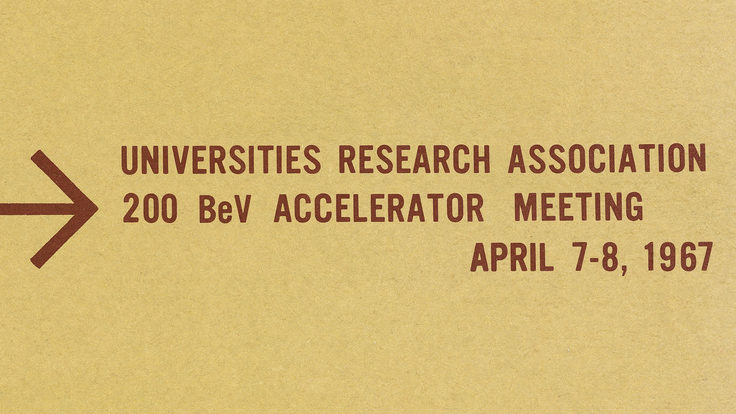
In 1967, 400 enthusiastic scientists met at Argonne National Laboratory to discuss plans to build a new 200 GeV accelerator and a national laboratory to house it.
The spotlight caught Todd Satogata. The camera zoomed in. “Did your particle beam shoot down a UFO?” the TV host asked. The accelerator physicist at RHIC, Brookhaven National Laboratory's Relativistic Heavy Ion Collider, smiled. Of course not.
If the proposed International Linear Collider (ILC) completes the evolution from physicists' dream to discovery machine, Jonathan Dorfan will know when and where the transforming moment occurred: August 20, 2004, in Beijing, China.
In August 2006, scientists working on the Compact Muon Solenoid experiment at CERN conducted a Cosmic Challenge to test components of their 12,500-ton CMS particle detector.
They started out scanning the cosmos for signs of extraterrestrial intelligence with SETI@ home. They’ve plotted chess moves, battled malaria, and folded proteins, all from their home computers.
With so much work to do on so many aspects of the Large Hadron Collider—the accelerator, detectors, software, physics, and so on—it’s hard not to get a bit lost.