Learn some particle accelerator basics from a Fermilab accelerator operator.
How do you keep a particle inside of an accelerator? Fermilab accelerator operator Cindy Joe explains.
Video URL
Have a burning question about particle physics? Let us know via email or Twitter (using the hashtag #asksymmetry). We might answer you in a future video!
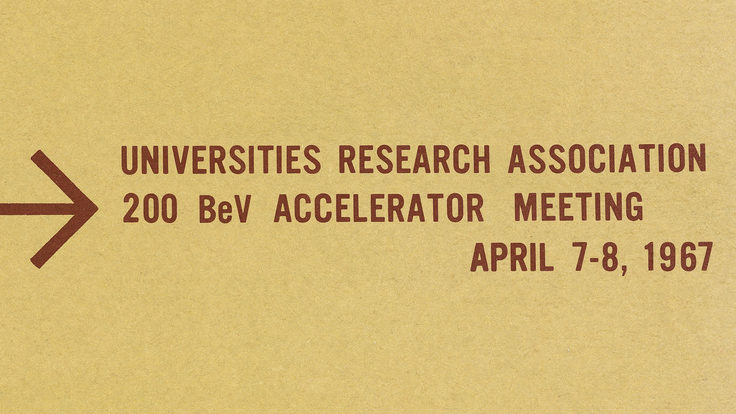
In 1967, 400 enthusiastic scientists met at Argonne National Laboratory to discuss plans to build a new 200 GeV accelerator and a national laboratory to house it.
The spotlight caught Todd Satogata. The camera zoomed in. “Did your particle beam shoot down a UFO?” the TV host asked. The accelerator physicist at RHIC, Brookhaven National Laboratory's Relativistic Heavy Ion Collider, smiled. Of course not.
As Clark Cully watched the movie Déjà Vu with his parents, something about the movie’s time machine—with its bright blue wedges of metal spewing a ring of wires—seemed eerily familiar.
On October 19, 1991, at 6:50 p.m., Bjørn Wiik logged the first collisions in the new electron-proton particle collider at the Deutsches Elektronen-Synchrotron in Hamburg.
Fermi National Accelerator Laboratory in Batavia, Illinois has a challenge: how will it maintain its central role as a place where particle accelerators produce groundbreaking discoveries in physic
Men and women wearing gaudy dresses, looking for customers under garish neon signs—this is a common sight in Kabuki-cho, Shinjuku, a famous entertainment and red-light district in Tokyo, Japan.