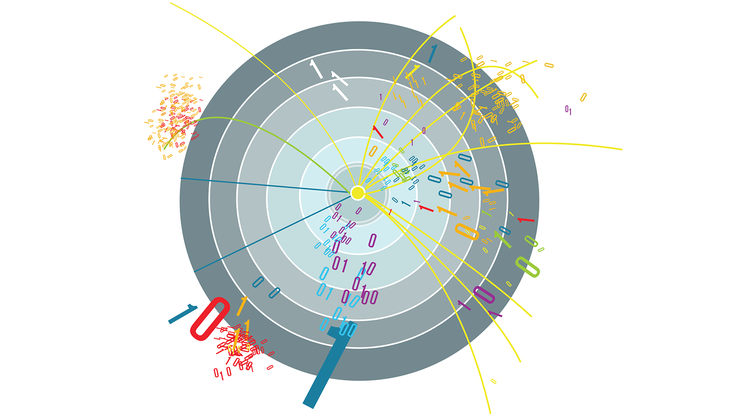
Learn some particle accelerator basics from a Fermilab accelerator operator.
How do you keep a particle inside of an accelerator? Fermilab accelerator operator Cindy Joe explains.
Video URL
Have a burning question about particle physics? Let us know via email or Twitter (using the hashtag #asksymmetry). We might answer you in a future video!
Baseball fans and physicists share two key loves: numbers and acronyms. While fans pore over statistics on RBIs, OBPs, and ERAs, physicists analyze data from particle accelerators such as RHIC, LHC, and CESR.
With the Large Hadron Collider up and running, expectations are high: Shouldn't discoveries start pouring in? These things don't happen overnight. We trace the long, careful path from intriguing data to official discovery.
When it comes to detecting neutrinos or particles of dark matter, four noble elements--helium, neon, argon, and xenon--stand out for their standoffishness.
Whenever I have met with high-energy physicists in recent months, conversation has always turned to the charge to the High Energy Physics Advisory Panel subpanel known as P5, the Particle Physics P
More than 500 tons of niobium would go into building the ILC. What's so great about niobium? Where does it come from? And is the Earth's supply going to run out?
Only detectors with the greatest precision capabilities will measure up to the machine seeking to explore supersymmetry, dark matter, the Higgs mechanism, and new physics that hasn't yet been
Designing the International Linear Collider is a global enterprise. Physicists and accelerator experts from around the world are collaborating to design the approximately 25-mile-long machine.
Particle physics is at a critical time, and its future depends on how well scientists can make their case to a diverse National Academy of Sciences panel.
As the Global Design Effort for the proposed International Linear Collider starts to take shape, an international collaboration of scientists simultaneously works on an alternative linear collider
Planning designing, and funding the proposed International Linear Collider (ILC), a 40-kilometer-long electron-positron collider costing billions of dollars, will require global participation and g