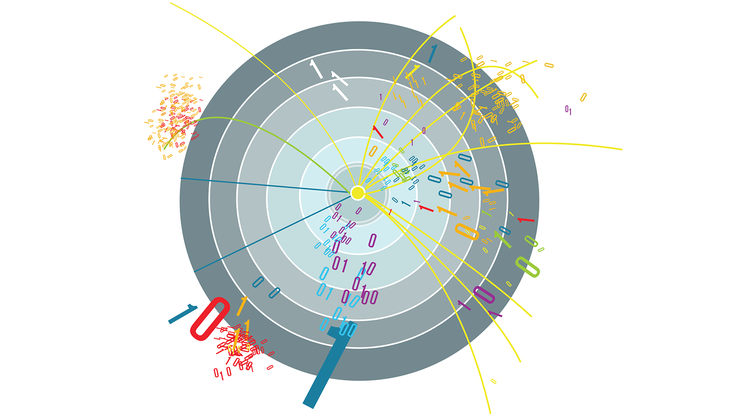
Learn some particle accelerator basics from a Fermilab accelerator operator.
How do you keep a particle inside of an accelerator? Fermilab accelerator operator Cindy Joe explains.
Video URL
Have a burning question about particle physics? Let us know via email or Twitter (using the hashtag #asksymmetry). We might answer you in a future video!
Baseball fans and physicists share two key loves: numbers and acronyms. While fans pore over statistics on RBIs, OBPs, and ERAs, physicists analyze data from particle accelerators such as RHIC, LHC, and CESR.
With the Large Hadron Collider up and running, expectations are high: Shouldn't discoveries start pouring in? These things don't happen overnight. We trace the long, careful path from intriguing data to official discovery.
When it comes to detecting neutrinos or particles of dark matter, four noble elements--helium, neon, argon, and xenon--stand out for their standoffishness.
Nature still has many surprises left for us. Discovering them is increasingly difficult (and expensive) as we dig deeper into the foundations of the universe.
In February, the Department of Energy's Office of Science and the National Science Foundation asked the High Energy Physics Advisory Panel "to form a committee to write a document" t
Designing the International Linear Collider is a global enterprise. Physicists and accelerator experts from around the world are collaborating to design the approximately 25-mile-long machine.
Particle physics is at a critical time, and its future depends on how well scientists can make their case to a diverse National Academy of Sciences panel.